The complete guide · Singapore · by way of the Nyonya kitchens of the Straits, and every coast where laksa is cooked

Laksa.
Fried until the oil splits.

叻沙 · LUCK-sah · an old Malay word for noodles, long before it meant this soup

A paste of chillies, shallots, galangal, turmeric, lemongrass, candlenuts and fermented shrimp, fried slowly until the red oil breaks free of it; a stock boiled from prawn shells; coconut milk stirred in at the end and never allowed to boil hard. Thick rice noodles go into the bowl with prawns, cockles, fishcake and fried beancurd, the orange gravy goes over them, and a fistful of shredded laksa leaf goes on top. In Katong the noodles are cut short so the whole bowl can be eaten with one spoon. Three countries cook it, and no two towns agree on what goes in it.

Origin: Peranakan kitchens of Melaka, Penang and Singapore, on an older noodle Reference bowl: Katong laksa, East Coast Road Cook time: about 2 hours, most of it the rempah and the stock Hawker price: around S$3 to S$7.50 a bowl
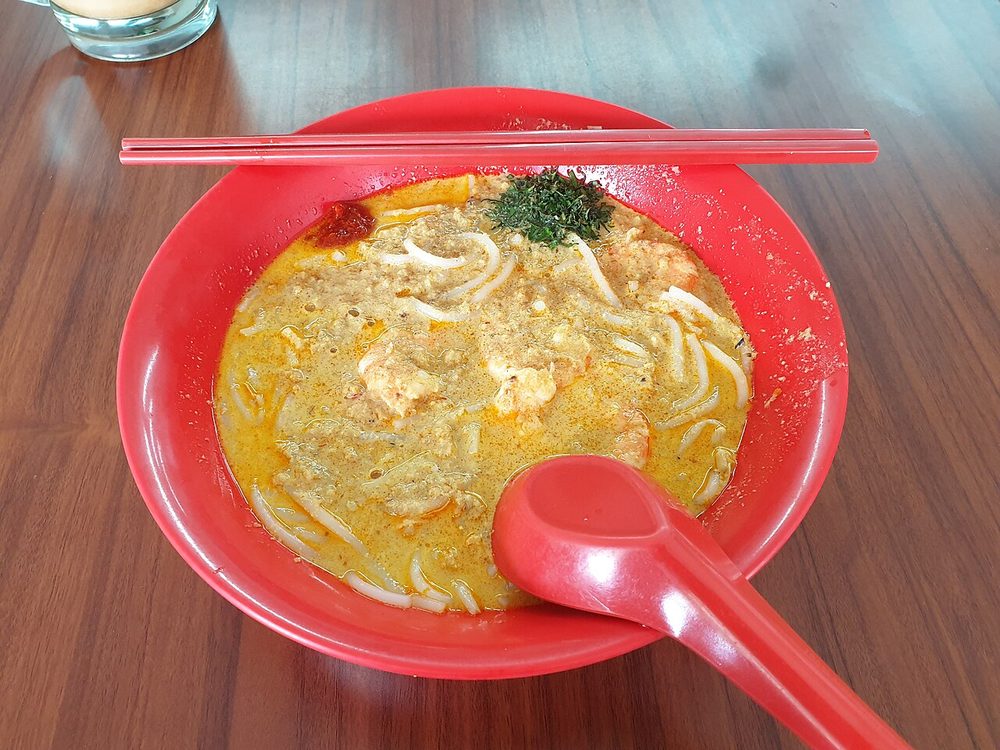
A red bowl of Katong laksa seen from above: thick rice noodles in orange coconut gravy, with chopped laksa leaf, a red plastic spoon and chopsticks on a wooden table
Katong laksa, Singapore. Short-cut noodles in a thick, orange gravy, a scattering of laksa leaf, and the spoon that is the only utensil you need.
Rempah (rum-PAH)The raw paste. Wet, bright red, sharp with shallot and garlic.
Pecah minyak (puh-CHAH min-YAK)"The oil breaks." Water gone, paste darkened, red oil pooling.
The gravy (kuah)Prawn stock and coconut milk over the fried paste. Orange, rich, gently simmered.
Chapter 1

What laksa actually is

Ask for laksa in Singapore, Penang and Kuching and you will get three bowls that share almost nothing except noodles. All three are right.

Laksa is a family of noodle soups from the Malay world: rice or wheat noodles in a spiced gravy, with seafood or chicken on top and fresh herbs over everything. The word itself, as Chapter 2 explains, seems to have meant "noodles" in the region for at least six hundred years. What goes around the noodles has been changing ever since.

The family splits into two big branches. Curry laksa, also called laksa lemak (lemak means rich, or creamy with coconut), is built on a fried spice paste, a stock of prawns or chicken, and coconut milk. Asam laksa (asam means sour) has no coconut at all: it is a thin, sharp broth of flaked mackerel, tamarind and torch ginger flower, best known from Penang. Between them sit dozens of regional versions, some white, some spaghetti-based, some made from a paste of more than twenty spices.

In Singapore, "laksa" with no other word means curry laksa, and the reference version is Katong laksa, named after the old Peranakan and Eurasian seaside district in the east of the island. It is the bowl this site is built around. Its gravy is thickened and made faintly gritty with ground dried shrimp, its toppings are prawns, cockles and fishcake, and its thick rice noodles are cut into short lengths so that the bowl is eaten with a spoon alone, no chopsticks. Singapore's National Heritage Board added laksa to its inventory of intangible cultural heritage in 2019.

One bowl, three layers

Every hawker is judged on the same three things, and regulars will tell you which one a given stall gets right.

The rempah (spice paste)

POUNDED · FRIED SLOWLY · UNTIL THE OIL SPLITS

Dried and fresh chillies, shallots, garlic, galangal, fresh turmeric, lemongrass, candlenuts, toasted belacan and coriander seed, ground to a paste and fried in plenty of oil for twenty minutes or more. Under-fried rempah tastes raw and harsh; burnt rempah tastes bitter. Everything else in the bowl rests on this step.

Colour
Bright red → brick red
Time
20 to 30 minutes
Done when
The oil separates

The gravy (kuah)

PRAWN STOCK · COCONUT MILK · DRIED SHRIMP

Stock boiled from fried prawn heads and shells goes onto the paste, then coconut milk at the end. Katong cooks add pounded dried shrimp, which thickens the gravy and gives it a faint, sandy grain. It should be rich but pourable, orange rather than red, with a little oil on the surface.

Texture
Creamy, slightly gritty
Heat
Moderate; more in the sambal
Rule
Never boil hard after the coconut

The bowl (noodles and toppings)

THICK BEE HOON · SEAFOOD · LAKSA LEAF

Thick rice vermicelli, blanched and cut; bean sprouts; prawns, cockles, sliced fishcake and tau pok, the spongy fried beancurd that soaks up gravy; sometimes a boiled egg. Shredded laksa leaf goes on last, with a spoonful of sambal for anyone who wants it hotter.

Noodle
Thick rice vermicelli
Herb
Laksa leaf, raw
Eaten with
A spoon
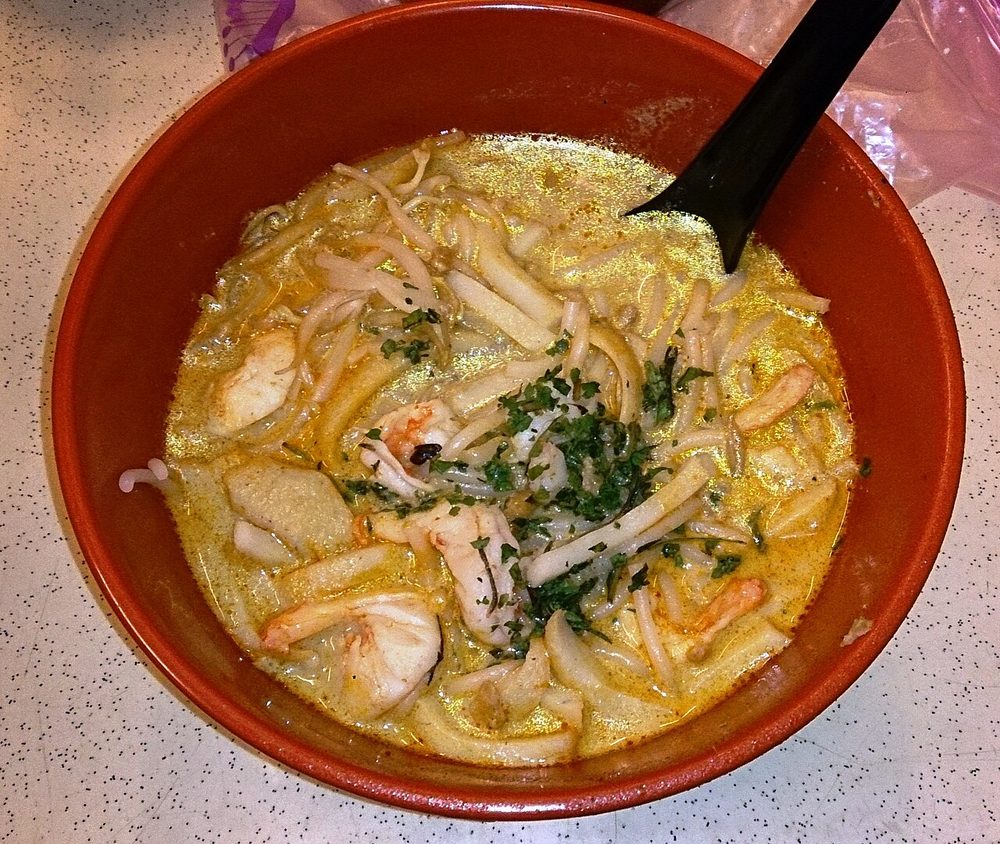
A close-up of Katong laksa in a red bowl: short-cut rice noodles, prawns, cockles and fishcake in orange gravy, scattered with chopped laksa leaf, with a black plastic spoon
Katong laksa, East Coast Road. Cut noodles, prawns, cockles, fishcake and laksa leaf, with the black spoon the stall gives you instead of chopsticks.

Why the noodles are cut

Cutting the noodles is the one thing every account of Katong laksa agrees on, and the one thing nobody agrees about. The Singapore food writer Leslie Tay credits Marine Parade Laksa, the stall on East Coast Road from which the Katong name spread, with being the first to pre-cut its bee hoon. A CNA report in 2024 told a different story: that the hawker known as Janggut cut them so that customers of his unlicensed street stall could finish quickly when enforcement officers appeared. Others credit Sungei Road Laksa, across the island. All three may be partly true. The result is a bowl you can drink like a soup, which is how most people eat it.

The National Museum of Singapore keeps a 1970s porcelain laksa bowl and spoon in its collection, with a note that laksa was traditionally eaten with only a spoon, and that early hawkers served it in small, locally made bowls.

Not just curry noodles

It is worth being clear about what laksa is not. It is not Thai red curry with noodles in it: there is no fish sauce base, no palm sugar, no Thai basil, and the paste is built on candlenut, galangal, turmeric and shrimp rather than on shrimp paste and dried spices alone. It is not northern Thai khao soi, which uses egg noodles, crisp fried noodles on top and a curry-powder base. It overlaps with Kuala Lumpur's curry mee, which locals there often call curry laksa, but curry mee is built on yellow egg noodles and usually carries long beans and sometimes cubes of pig's blood. And it is not ramen: the stock matters, but the paste matters more.

Flavour profile
Rich, savoury, gently hot, perfumed with laksa leaf and lemongrass
Core aromatics
Shallot, garlic, galangal, turmeric, lemongrass, chilli
The savoury base
Belacan, dried shrimp, prawn-shell stock
The richness
Coconut milk and candlenut
Signature technique
Frying the paste until the oil splits: pecah minyak
Served with
Sambal chilli, extra laksa leaf, a spoon
Chapter 2

An old word, a Nyonya kitchen

The noodle is older than the community that made laksa famous. The gravy belongs to the Peranakan women who cooked it.

The usual story of laksa is one of marriage. From the fifteenth century, Chinese traders settled in the port towns of the Strait of Malacca, first in Melaka itself and later in Penang and Singapore, and married local women. Their descendants became the Peranakan, or Straits Chinese: the men called Baba, the women Nyonya. Their cooking, Nyonya food, put Chinese ingredients and habits together with the spice pastes, coconut milk and souring agents of the Malay kitchen. Singapore's National Heritage Board, National Geographic and most food historians place laksa there: a Chinese bowl of noodles and seafood, made in a Malay way.

That story is broadly right, but it leaves out the noodle. The word laksa was in use in the region before the Peranakan community took shape, and it seems to have meant the noodle, not the soup.

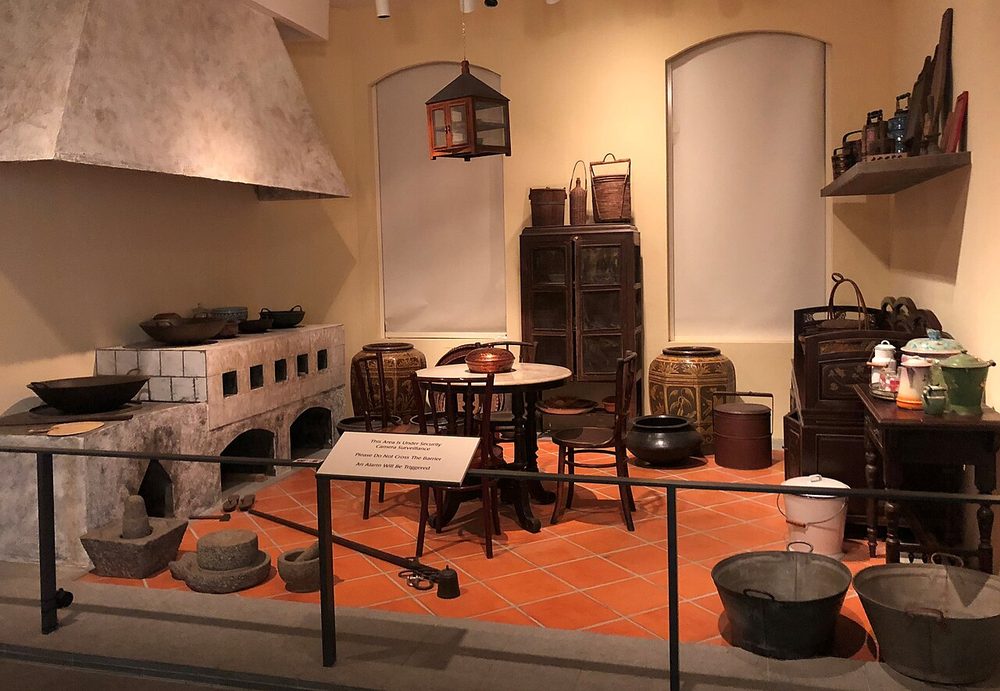
A reconstructed interwar Peranakan kitchen in a museum, with a tiled wood-fired stove, stone mortars, clay pots and wooden cupboards
A Peranakan kitchen of the interwar years. Reconstructed at the Peranakan Museum, Singapore: the wood-fired stove, the stone mortars, the pots for slow gravies.

The Nyonya kitchen

Nyonya cooking had a reputation, among Peranakan families themselves, for being laborious and exacting. A young Nyonya was judged on her rempah: how finely she pounded it in the stone mortar, the batu lesong, and how patiently she fried it. The paste for a laksa might take an hour of pounding before it went near the fire.

Laksa fitted that kitchen exactly. It needs a long, careful paste, a stock that wastes nothing (the shells and heads of the prawns), coconut milk pressed by hand from grated coconut, and herbs from the garden. It was cooked at home, for families and for gatherings and weddings, as well as sold in the street.

Where the word comes from

Nobody has settled the etymology of laksa, and you will read several theories presented as fact. These are the four that matter, from best supported to least.

lakhsha Persian · "noodle", "vermicelli"
FAVOURED BY · DICTIONARY MAKERS AND FOOD HISTORIANS

Persian and Hindustani had a word for noodles in broth, lakhsha, with relatives across Asia and Europe: Russian lapsha, Yiddish lokshen. R. J. Wilkinson's Malay dictionary of 1908 lists laksa, "a native vermicelli", as a Persian loanword. The Oxford Companion to Food takes the same line, with Muslim traders carrying the word east.

hanglaksa Old Javanese · "vermicelli maker"
THE EVIDENCE · A 14TH-CENTURY INSCRIPTION

A Majapahit-era inscription from Biluluk in east Java lists hanglaksa among local trades. The French historian Denys Lombard read it as "vermicelli maker". It is dated to 1391 or 1393, depending on the source, and it suggests that noodles called laksa were being made for sale in Java six centuries ago.

lakṣa Sanskrit · "a hundred thousand"
POPULAR · BUT A DIFFERENT WORD

Malay really does have a laksa meaning "ten thousand", from Sanskrit, and you will often read that the soup is named for its many ingredients or strands. William Marsden's dictionary of 1812 gives only the number; Wilkinson treated the noodle and the number as two separate words that happen to sound the same.

la sha 辣沙 Chinese · "spicy sand"
FOLK ETYMOLOGY · MEMORABLE, UNLIKELY

The story goes that Chinese diners named it for the gritty texture of the ground dried shrimp. It is a good description of Katong laksa, but it cannot explain why the word meant plain noodles in Java in the 1390s, or in Dutch cookbooks of the 1900s. The modern Chinese spelling, 叻沙, is just a sound-alike.

Put together, the best reading is that laksa began as the name of a noodle known across the archipelago, perhaps brought by Persian and Indian Muslim traders, and that Peranakan cooks in the Straits ports built the coconut gravy, the prawn stock and the seafood toppings around it. Some Malay historians go further: Khir Johari, in The Food of Singapore Malays (2021), describes Katong laksa as a fairly modern Straits Chinese dish, possibly shaped by Johor's Malay laksa. Both pictures fit the evidence. Neither is proven.

Katong, by the sea

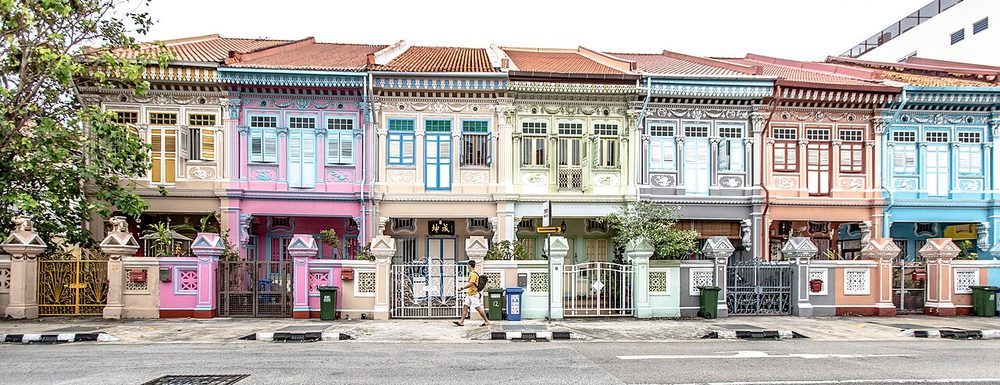
Katong lies along the east coast of Singapore. East Coast Road was planned in 1828 but only built in 1902, and through the early twentieth century the district was a place of coconut plantations and seaside bungalows, home to wealthy Peranakan and Eurasian families. Joo Chiat, just inland, was largely coconut estate under the Peranakan landowner Chew Joo Chiat. In the 1950s and 60s the centre of Katong was the "Roxy area", around the Roxy, Odeon and Palace cinemas, and the sea came up nearly to the road. Land reclamation from the 1960s onwards pushed the shoreline out, and Marine Parade was built on the new ground.

It was here, on the five-foot ways of Joo Chiat and along East Coast Road "when it was still next to the sea", as Leslie Tay puts it, that a Hokkien hawker with a beard on his chin, known to everyone as Janggut, began selling Peranakan-style laksa from a pushcart in the 1940s. Chapter 3 follows what happened next.

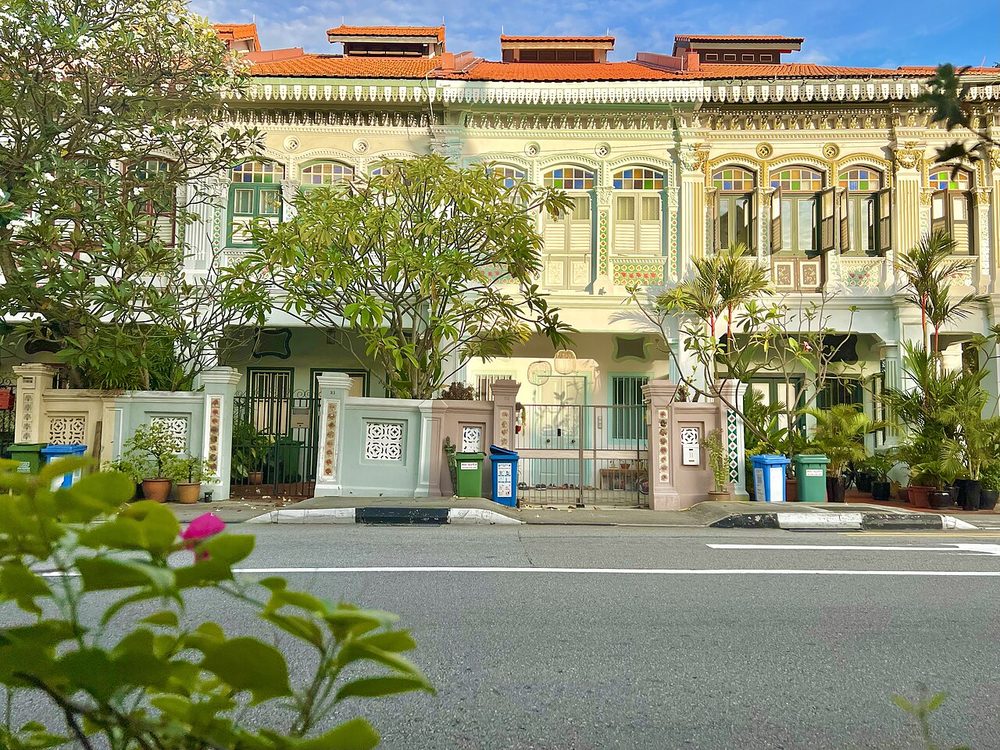
A long row of pastel-coloured, ornately decorated Peranakan terrace houses on Koon Seng Road in Joo Chiat, Singapore
Koon Seng Road, Joo Chiat. The terrace houses of Katong's Peranakan heartland, a few minutes' walk from the laksa stalls of East Coast Road.

Where it went

Follow the Peranakan, the Malay cooks who adapted their dishes, and the trade routes of the archipelago, and you find laksa. Every stop made it its own.

Straits SettlementsMelaka and Penang

The old Peranakan towns. Melaka keeps a Nyonya curry laksa of chicken and prawn; Penang made the sour asam laksa that is now its emblem.

The citySingapore

Katong laksa with its cut noodles and dried-shrimp gravy, curry laksa at every hawker centre, claypot and charcoal laksa, and the Malay laksa Siglap.

The peninsulaMalaysia's states

Almost every state has a laksa: fish-based Laksa Utara in Kedah, Perlis and Perak; spaghetti laksa in Johor; the white, rolled laksam of Kelantan and Terengganu.

BorneoSarawak

A paste of more than twenty spices, chicken and prawn, omelette strips and lime. Credited to a Teochew hawker in Kuching in the 1940s.

SouthIndonesia

Laksa Betawi in Jakarta, laksa Bogor with fermented oncom, Banjar, Palembang and Medan versions. Some served with rice cakes rather than noodles.

DiasporaAustralia and Britain

Curry laksa became a staple in Australia, especially Darwin, which holds a laksa festival every October. London's Malaysian and Singaporean cooks serve it too.

Chapter 3

A history in bowls

An inscription, two old dictionaries, a Dutch cookbook, a bearded hawker, a landlord's revenge and a celebrity chef who lost.

The early dates are scholarly; the later ones were kept by hawkers and their families, by word of mouth, and argued over in newspapers. Where sources disagree, both dates are given, and where a claim rests on one source or on legend, it says so.

1391 or 1393
"Vermicelli makers" in Java

The Biluluk inscription, from the Majapahit kingdom of east Java, lists hanglaksa among the trades of a village. Denys Lombard read the word as "vermicelli maker". It is the earliest known trace of laksa as a word for food.

1400s
Chinese traders settle in Melaka

Chinese merchants marry into local families in the Malacca sultanate. Their descendants, the Peranakan, will build the coconut-gravy laksa over the following centuries.

1812
Marsden's dictionary

William Marsden's Dictionary of the Malayan Language lists laksa only as a number: ten thousand. No food.

1885
The Sultan's spaghetti

Sultan Abu Bakar of Johor travels in Europe, including Italy. Johor legend says he came home and had his cooks make laksa with spaghetti, and Laksa Johor still uses it. Malaysia's culture department repeats the story; no record from the time confirms it.

1866–1902
Laksa in the Dutch Indies cookbooks

Cookbooks for the Dutch in Java include several laksa recipes. The definitive 1902 edition of J. M. J. Catenius-van der Meijden's Nieuw volledig Oost-Indisch kookboek has a "kerrie laksa" of chicken in coconut milk with chilli, candlenut, galangal, turmeric, lemongrass and roasted shrimp paste, served with fried prawns and sambal. It also uses "laksa" for the noodle itself.

1908
Two words, one spelling

R. J. Wilkinson's Malay dictionary separates laksa the number, from Sanskrit, and laksa "a native vermicelli", from Persian.

1940s
Janggut's pushcart

Ng Juat Swee, a Hokkien hawker nicknamed Janggut ("beard") for the hairs on a mole on his chin, sells Peranakan-style laksa in Katong with his brother Ng Chwee Seng, on East Coast Road and the five-foot ways of Joo Chiat.

Late 1940s
Sarawak laksa, Kuching

A Teochew immigrant, Goh Lik Teck, is credited with first selling the Sarawak version on Carpenter Street. In the 1960s Tan Yong Him refines the paste and sells it in jars, the start of Sarawak's laksa-paste brands.

1950 or 1963
Marine Parade Laksa, 49 East Coast Road

The Ng family's laksa moves into the coffee shop on the corner of Ceylon Road. Sources disagree on the year and on which brother ran it. It is the stall, Leslie Tay writes, that first pre-cut the noodles, followed a year or two later by Roxy Laksa outside the Roxy cinema. Between them they make "Katong laksa" a name.

1956
Sungei Road Laksa

Wong Yew Poh starts selling laksa outside an ice factory on Sungei Road, keeping the gravy hot over charcoal. The stall, now on Jalan Berseh and run by his family, still uses charcoal.

1960s
Fifty cents a bowl

A bowl of Roxy laksa costs 50 cents, when a back-stalls cinema ticket costs $2. Schoolboys eat it before the films.

1978
Roxy moves on

The Roxy cinema is sold and Roxy Laksa moves to the East Coast Lagoon Food Village. Street hawkers across Singapore are being moved into hawker centres.

1986
Janggut dies

His children and relatives carry on the recipe, and the name.

1998
"328 Laksa"

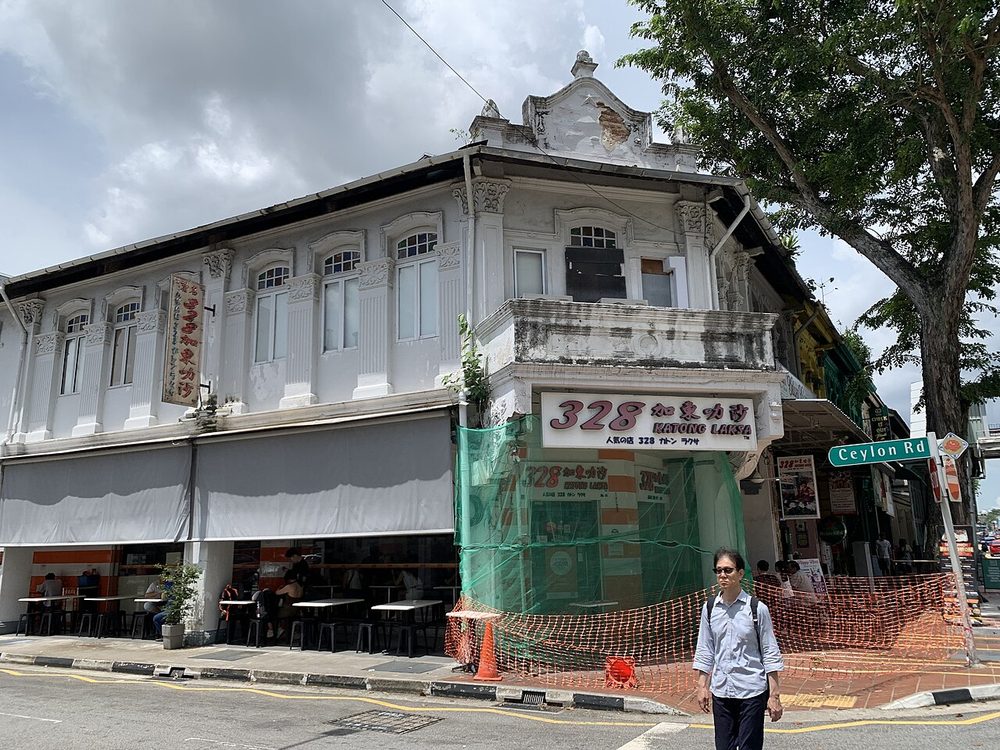
Rising rent pushes the Ng family out of 49 East Coast Road. A former stall assistant, named by Michelin as Lucy Lim and elsewhere as Nancy Lim, opens her own stall there and calls it 328, which sounds like "prosperous business" in Cantonese.

1999
The Katong laksa war

The landlord ends 328's lease and opens her own laksa stall at No. 49; 328 moves next door to No. 51. Janggut's relatives open at No. 57. At one point stalls at Nos. 45, 47, 49, 51 and 57 all claim to sell the original Katong laksa. The Straits Times runs the story; Violet Oon judges the bowls. Two of the stalls close.

2005
Bourdain in Kuching

Anthony Bourdain eats Sarawak laksa for breakfast at Choon Hui Cafe on No Reservations. He returns in 2015 for Parts Unknown and posts a picture captioned "Breakfast of the Gods". Kuching has not let anyone forget it.

2009
"Hijacked" food

Malaysia's tourism minister Ng Yen Yen, launching a food festival in September, says other countries cannot keep hijacking Malaysian food, and names laksa, chicken rice, chilli crab, nasi lemak and bak kut teh. She names no country. Singapore's food writers take it personally.

2011
Number seven in the world

CNNGo's list of the world's fifty most delicious foods ranks Penang asam laksa seventh. Singapore-style laksa is further down the list.

2013
Gordon Ramsay loses to 328

In the Singtel Hawker Heroes Challenge at Newton Food Centre on 7 July, Ramsay cooks laksa against 328 Katong Laksa. The public vote goes to 328, 59.5 per cent to 40.5. He also loses chicken rice and wins chilli crab. The same year a reviewer of instant noodles, The Ramen Rater, names Prima Taste's Singapore laksa the best instant noodle in the world.

2016
Michelin arrives

The first Michelin Guide Singapore gives Bib Gourmand listings to 328 Katong Laksa, Famous Sungei Road Trishaw Laksa and a claypot laksa stall at Alexandra Village. The lists change year to year; 328 drops off in 2018.

2019
National heritage, and a festival in Darwin

In March, Singapore's National Heritage Board adds laksa to its inventory of intangible cultural heritage. In October, Darwin holds its first International Laksa Festival; it becomes an annual month of laksa.

2020
UNESCO: hawker culture

On 16 December, "Hawker Culture in Singapore" is inscribed on UNESCO's Representative List of the Intangible Cultural Heritage of Humanity. Laksa is not named in it, but it is one of the dishes that the hawker centre exists for.

2024
Not on the list

Malaysia gazettes ten dishes as national heritage food. Laksa, which its tourism minister had claimed fifteen years earlier, is not one of them.

A white two-storey corner shophouse on East Coast Road, Singapore, with the 328 Katong Laksa signboard over the shopfront
51 East Coast Road, 2025. 328 Katong Laksa, next door to the corner where Marine Parade Laksa once traded.
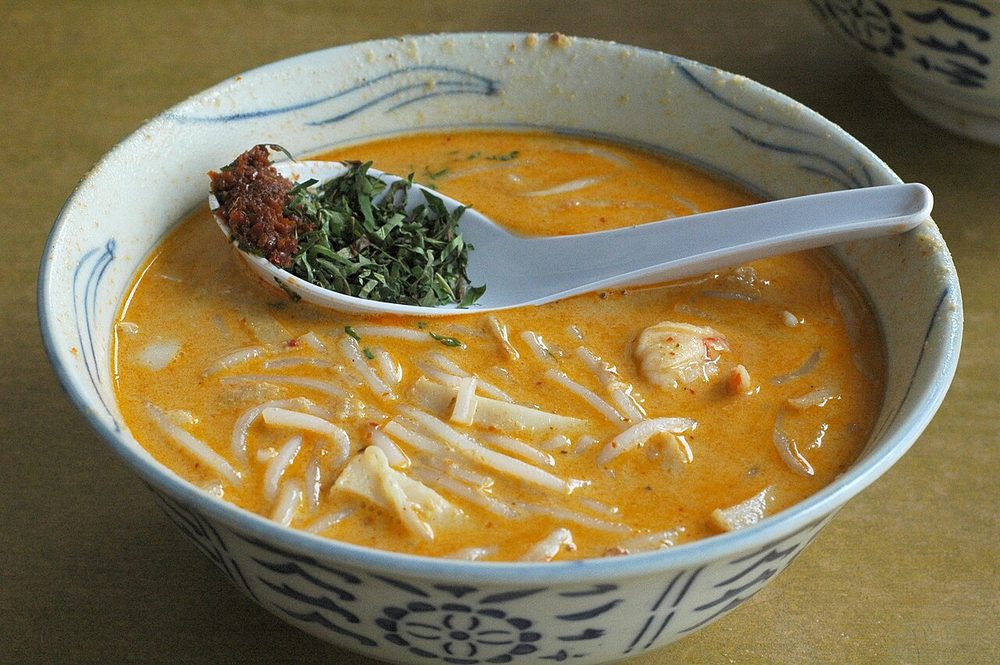
A blue and white bowl of Katong laksa with a porcelain spoon resting in it, holding chopped laksa leaf and sambal
Katong laksa, served the old way. A spoon with laksa leaf and a dab of sambal on it, ready to stir in.

Whose laksa?

More places can claim laksa than any other dish on this site. Java has the earliest word. Melaka and Penang have the oldest Peranakan communities, and Penang has the asam laksa that topped a world ranking. Malaysia has a laksa in almost every state. Singapore has Katong, a heritage listing, and the bowl that beat Gordon Ramsay. Indonesia has its own laksa family, and Thailand a close cousin.

The most honest answer is that laksa is the noodle soup of the whole Malay archipelago, finished in many kitchens, with the Peranakan of the Straits as the cooks who made its most famous versions. It is the one dish in this guide that is genuinely shared.

Watch

Laksa on film

You need to see the paste darken and the oil come loose, and hear an East Coast Road queue argue about who was first. Six films, chosen for what they show.

Katong laksa from scratch

The Singapore-born chef Elizabeth Haigh, author of Makan, makes Katong laksa at home from the rempah up, in English. The clearest full demonstration of the recipe in Chapter 5.

ELIZABETH HAIGH · Open on YouTube

The story of Janggut

A short film from Singapore's CNA on the bearded Katong hawker whose laksa started it all, and the family that carries on his recipe.

CNA INSIDER · Open on YouTube

The laksa war

A longer CNA documentary on the rival stalls of East Coast Road and the question nobody there can answer: which one has the original recipe? The story behind Chapter 7.

CNA INSIDER · ON THE RED DOT · Open on YouTube

Gordon Ramsay at 328

Ramsay visits 328 Katong Laksa to learn the dish before the 2013 Hawker Heroes Challenge. He lost the laksa round by nineteen points.

INSING TV, 2013 · Open on YouTube

Asam laksa at Air Itam

The other branch of the family: Penang's sour fish and tamarind laksa at the famous market stall in Air Itam, with no coconut in sight. Compare it with the bowls in Chapter 4.

MARK WIENS · Open on YouTube

Breakfast in Kuching

A short visit to the Sarawak laksa shop that Anthony Bourdain filmed on two different shows. Omelette strips, chicken, prawns and lime, at breakfast.

BORNEO DISCOVERY ROUTE · Open on YouTube

More: Mark Wiens at the charcoal-fired Sungei Road Laksa · eight regional laksas cooked side by side · Pailin's Kitchen's home laksa lemak · Bourdain's full Parts Unknown: Borneo

Chapter 4

The laksa family

Coconut or tamarind, rice noodles or spaghetti, red or white, in a bowl or on a plate. Laksa is a family held together by one word.

Malaysian food writers like to say that every state has its own laksa, and it is nearly true. What holds the family together is a noodle, a spiced broth or gravy made from fish, prawns or chicken, and a pile of fresh herbs and raw vegetables on top. What divides it is almost everything else. The first split is the broth.

By what's in the gravy

Curry laksa

laksa lemak · "rich laksa"

The Singapore and Kuala Lumpur default. A fried rempah, prawn or chicken stock and coconut milk, with rice noodles or a mix of rice and yellow egg noodles. Toppings vary by stall: prawns, cockles, chicken, tau pok, fishcake, egg. Many stalls use a curry powder in the paste.

Broth
Coconut, spiced
Colour
Orange to red

Katong laksa

Nyonya laksa · Singapore

Curry laksa made the Peranakan way. Ground dried shrimp thickens the gravy, the toppings are cockles, prawns and fishcake, and the thick bee hoon is cut short for a spoon. No yellow noodles. The bowl on this site's hero.

Broth
Coconut, dried shrimp
Eat with
A spoon only

Asam laksa

AH-sum · "sour laksa"

No coconut at all. Mackerel is poached and flaked into a broth soured with tamarind or dried asam gelugur, perfumed with lemongrass, galangal and torch ginger flower. Topped with raw onion, cucumber, pineapple, mint and chilli, with a spoonful of thick black prawn paste, hae ko.

Broth
Fish, tamarind
Taste
Sour, hot, fishy, sweet

Sarawak laksa

Kuching · Borneo

Built on a paste of more than twenty ingredients, with dry spices such as cumin, coriander, clove, nutmeg and cardamom alongside the chillies and galangal, cooked down for hours. Chicken and prawn stock, coconut milk and tamarind; thin vermicelli; shredded chicken, prawns, omelette strips, bean sprouts and a wedge of lime.

Broth
Spiced, tangy, coconut
Eaten
At breakfast

White laksa

laksam · kuah putih · east coast

The pale branch of the family, from Kelantan and Terengganu. Fish and coconut milk are cooked into a thick, white gravy with little or no chilli, and served over wide rice sheets rolled and sliced into spirals, with raw herbs and vegetables, ulam, and sambal on the side.

Broth
Fish, coconut, white
Noodle
Rolled rice sheets

Spaghetti laksa

Laksa Johor

A thick gravy of flaked fish, fish curry powder, coconut milk and toasted coconut paste, kerisik, poured over spaghetti on a plate, with cucumber, bean sprouts, onion, laksa leaf, calamansi and sambal belacan. Traditionally eaten with the hand, and made for Hari Raya and family gatherings.

Broth
Fish, coconut, kerisik
Noodle
Spaghetti
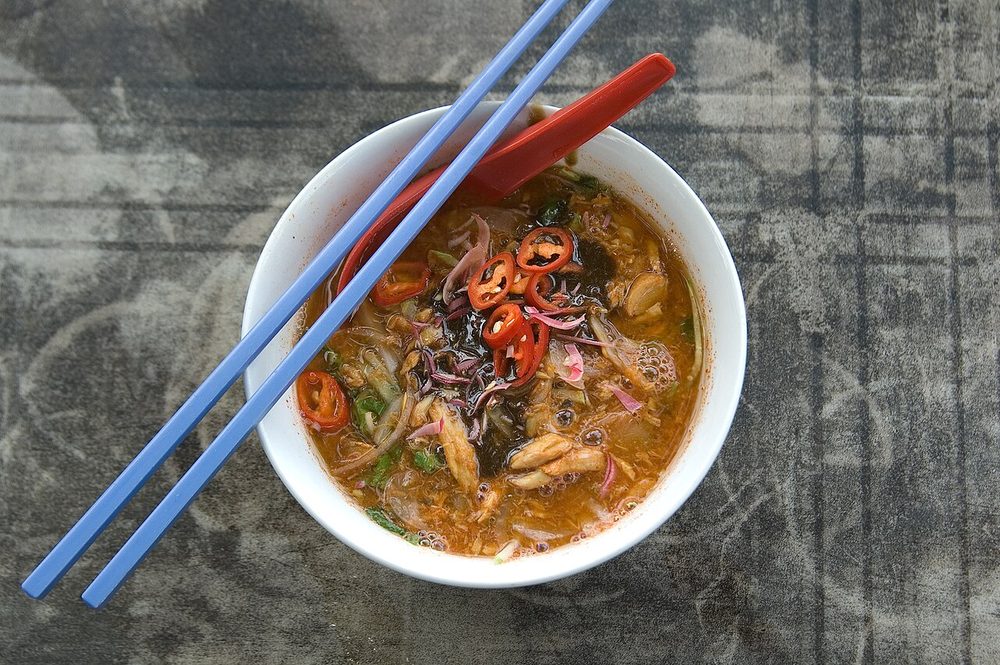
A white bowl of Penang asam laksa seen from above, with sliced red chilli, onion, mint and cucumber on a dark broth, and blue chopsticks
Penang asam laksa. The sour branch: fish and tamarind broth, raw onion, chilli, cucumber and mint, no coconut.
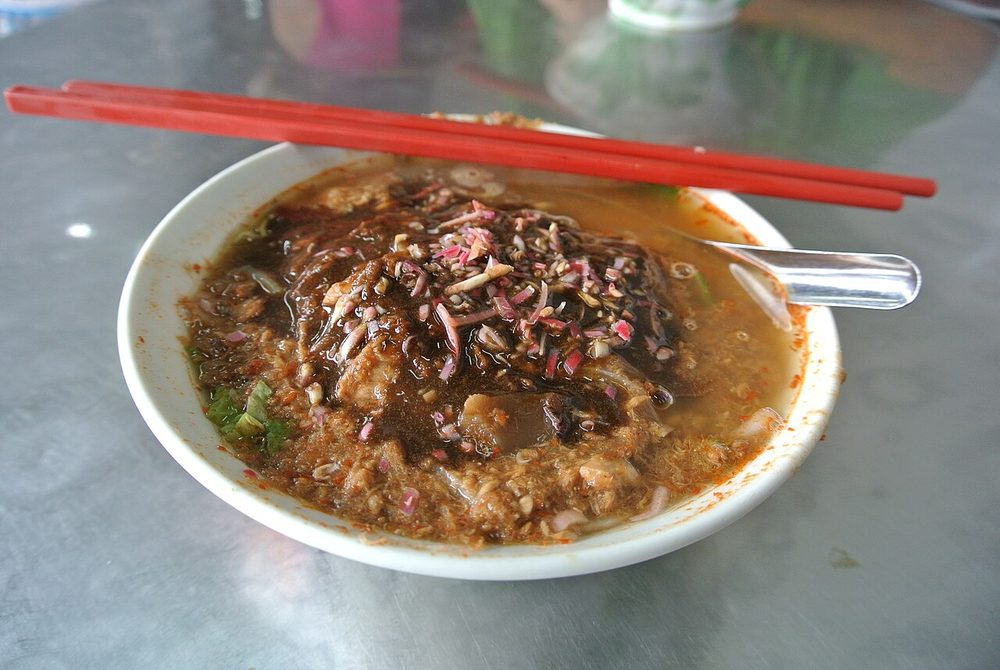
A bowl of asam laksa at Air Itam market in Penang, topped with flaked fish, shredded vegetables and a dark smear of prawn paste, with red chopsticks
Air Itam, Penang. The market stall's bowl, with the dark streak of hae ko, prawn paste, across the top.

By where it was cooked

The second way to divide the family is by place. Laksa changed as it moved, and Malaysians in particular will drive across a state for a particular town's version.

Singapore: Katong and beyond

East Coast Road · every hawker centre

Katong laksa on East Coast Road; ordinary curry laksa, often with yellow noodles and chicken, almost everywhere else. Claypot laksa arrives bubbling in its pot, the gravy slow-cooked with chilli padi and belacan. Sungei Road still heats a lighter gravy over charcoal and tops it with nothing but cockles and fishcake. The Malay laksa Siglap, named after a village on the east coast, is close to Johor's.

Broth
Coconut, shrimp
Noodle
Thick bee hoon, cut
Toppings
Cockles, prawns, fishcake

Penang

asam laksa · Air Itam · Balik Pulau

The home of asam laksa, and of the CNN ranking that made it famous. Flaked mackerel, tamarind, torch ginger, round rice noodles and hae ko. Penang also has a creamier "Siamese laksa", made with coconut milk and a fried paste, a reminder that the border with Thailand is not far north.

Broth
Fish, tamarind
Noodle
Round rice noodles
Topping
Hae ko, pineapple, mint

Kedah, Perlis and Perak

Laksa Utara · "northern laksa"

Sardine or mackerel blended into the broth, soured with asam gelugur and scented with laksa leaf and torch ginger, over rice noodles with a boiled egg. Perlis sometimes uses catfish or eel. In Ipoh it may come under a lacy fried-egg "nest"; in Kuala Kangsar, with handmade wheat noodles.

Broth
Fish, sour
Noodle
Rice, or wheat
Topping
Egg, cucumber, herbs

Kelantan and Terengganu

laksam · laksa kuah putih · kuah merah

The east coast's laksam: wide steamed rice sheets rolled up and sliced, under a thick white gravy of fish and coconut, with raw vegetables. Terengganu also has a white laksa with black-pepper heat and a red one with spices and kerisik. Across the border in southern Thailand, the same dish is called lasae.

Broth
Fish, coconut
Noodle
Rolled rice sheets
Heat
Low; sambal on the side

Johor

Laksa Johor · the Sultan's spaghetti

Spaghetti under a thick fish-and-coconut gravy thickened with kerisik, eaten from a plate with the fingers, with a heap of raw vegetables and herbs. The story that Sultan Abu Bakar brought the idea back from Italy in the 1880s is beloved and unproven. A festive dish, made for Hari Raya and for guests.

Broth
Fish, coconut, kerisik
Noodle
Spaghetti
Served
On a plate

Melaka and Kuala Lumpur

Nyonya laksa · curry mee

Melaka's Nyonya laksa uses a chicken and shrimp broth, no fish, soured lightly with asam keping and thickened with candlenut, over thick or thin rice noodles with fish balls, tau pok, egg, chicken and prawns. In Kuala Lumpur, "curry laksa" and "curry mee" mean much the same: yellow egg noodles, tau pok, cockles, long beans, mint.

Broth
Chicken, shrimp, coconut
Noodle
Rice, or egg
Topping
Tau pok, long beans

Sarawak

Kuching · "Breakfast of the Gods"

Borneo's laksa, eaten in the morning. The paste is the secret, and many cooks buy it ready-made from one of Kuching's family paste makers. Chicken, prawns, omelette strips and thin vermicelli in a tangy coconut broth, with sambal belacan and lime on the side.

Broth
Spiced, sour, coconut
Noodle
Thin vermicelli
Topping
Omelette, chicken, prawn

Indonesia

laksa Betawi · laksa Bogor · Banjar · Palembang

Indonesia has its own branch. Jakarta's laksa Betawi is a coconut and dried-shrimp broth with turmeric and coriander over rice cakes, ketupat, with lemon basil. Laksa Bogor adds oncom, a fermented cake. Banjarmasin's uses snakehead fish and noodles shaped into balls; Palembang's laksan is slices of fishcake in coconut broth.

Broth
Coconut, turmeric
Base
Noodles or rice cakes
Herb
Lemon basil

Thailand and Australia

a cousin, and a second home

Thailand's khanom chin nam ya is fermented rice noodles under a curry of pounded fish, shrimp paste and coconut milk: a close relative, not a descendant. Australia took up curry laksa so completely that Darwin calls itself the laksa capital and holds a month-long festival; Melbourne's Laksa King has traded since 1998.

Thai
Fish curry, fermented noodles
Australian
Curry laksa, egg noodles
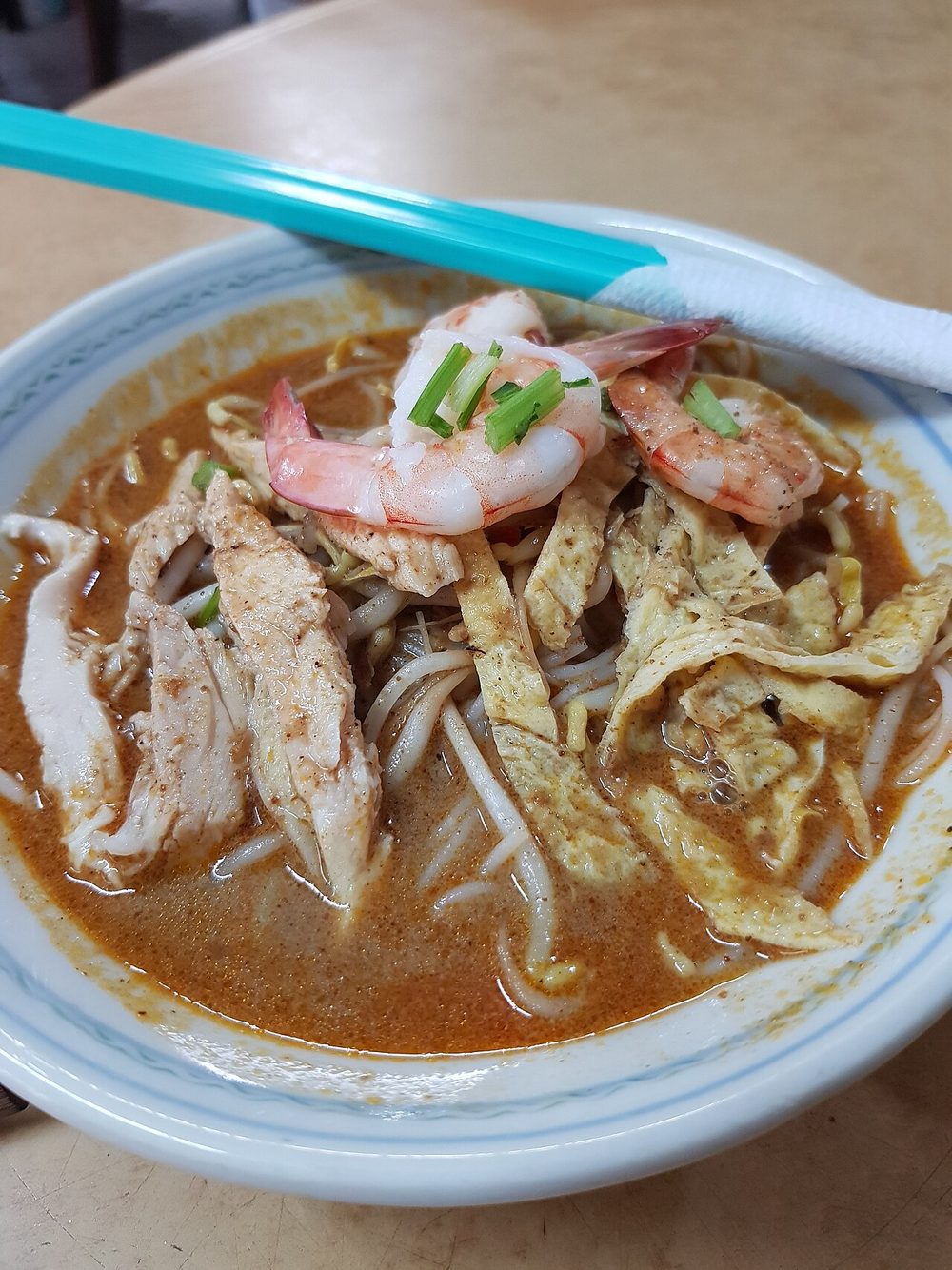
A bowl of Sarawak laksa with halved prawns, shredded chicken, omelette strips and bean sprouts in a brown-orange broth
Sarawak laksa, Choon Hui, Kuching. The bowl Bourdain ate: prawns, chicken and omelette strips in a tangy, deep-spiced broth.
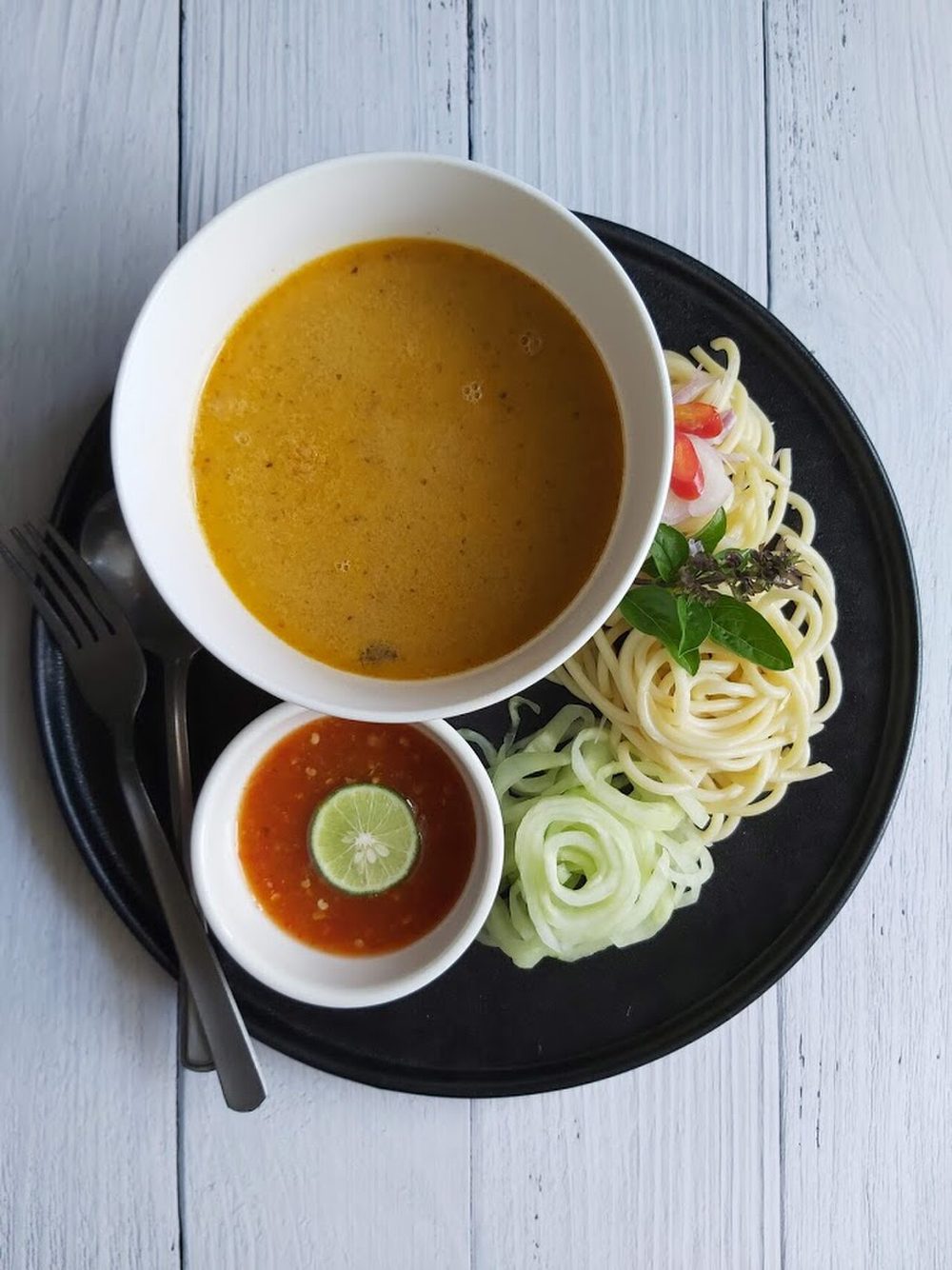
Laksa Johor seen from above: spaghetti on a black plate with cucumber and herbs, a bowl of thick orange fish gravy, and a saucer of sambal with a calamansi half
Laksa Johor. Spaghetti, a bowl of thick fish and kerisik gravy, raw vegetables, sambal and calamansi.
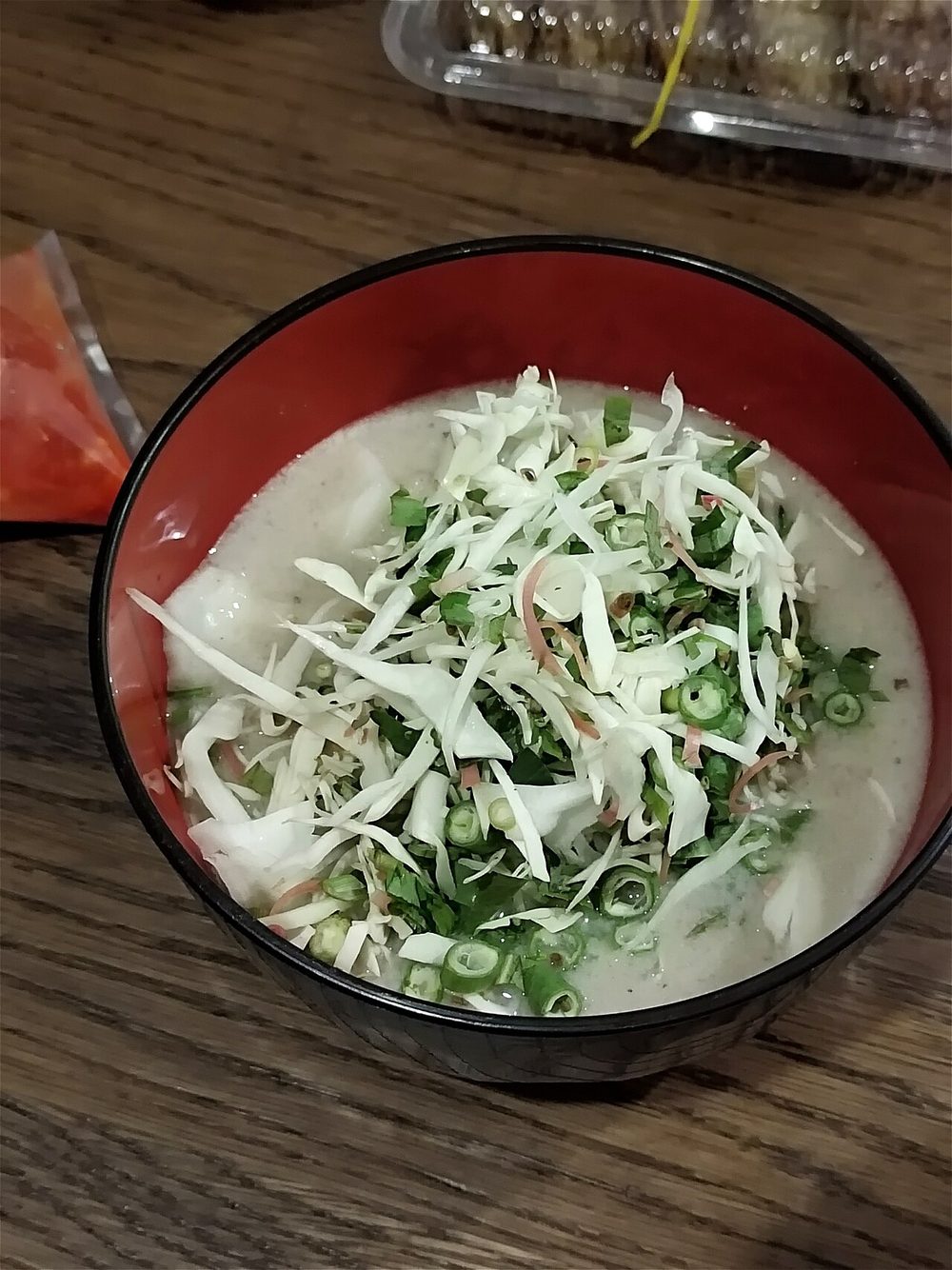
A bowl of laksam: rolled rice noodles under a white coconut and fish gravy, topped with shredded raw cabbage, cucumber and herbs
Laksam, Kelantan style. Rolled rice sheets under the white gravy, buried in raw shredded vegetables and herbs.
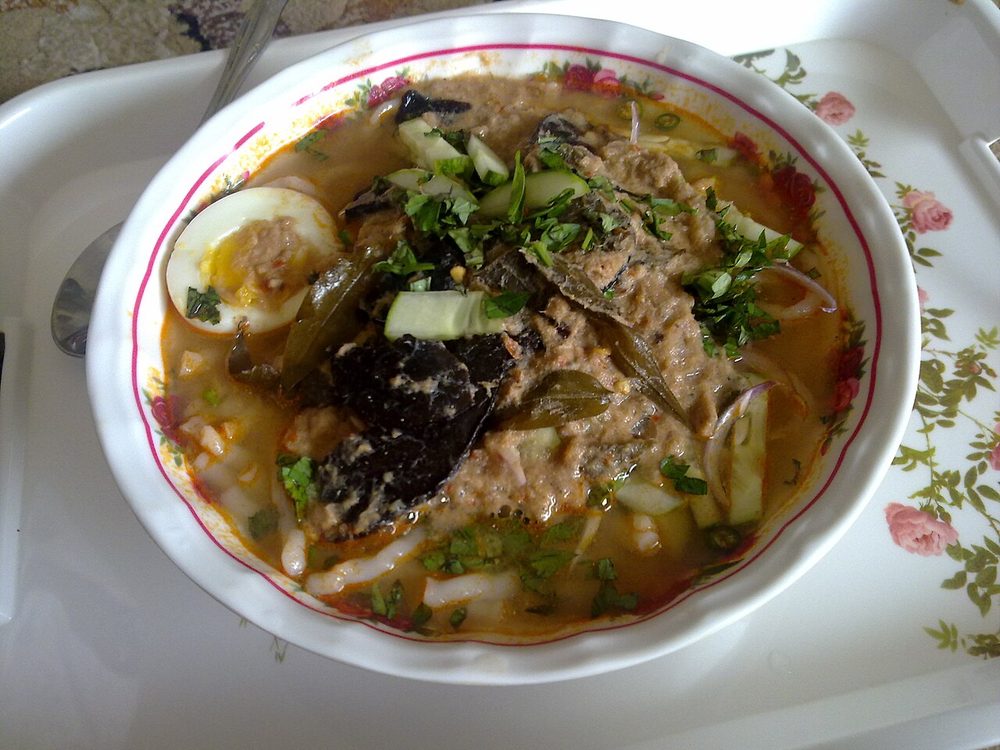
A bowl of Laksa Kedah with a halved boiled egg, cucumber and herbs on a thick fish broth over rice noodles
Laksa Kedah. Northern laksa: thick fish broth, rice noodles, half an egg and a tangle of herbs.
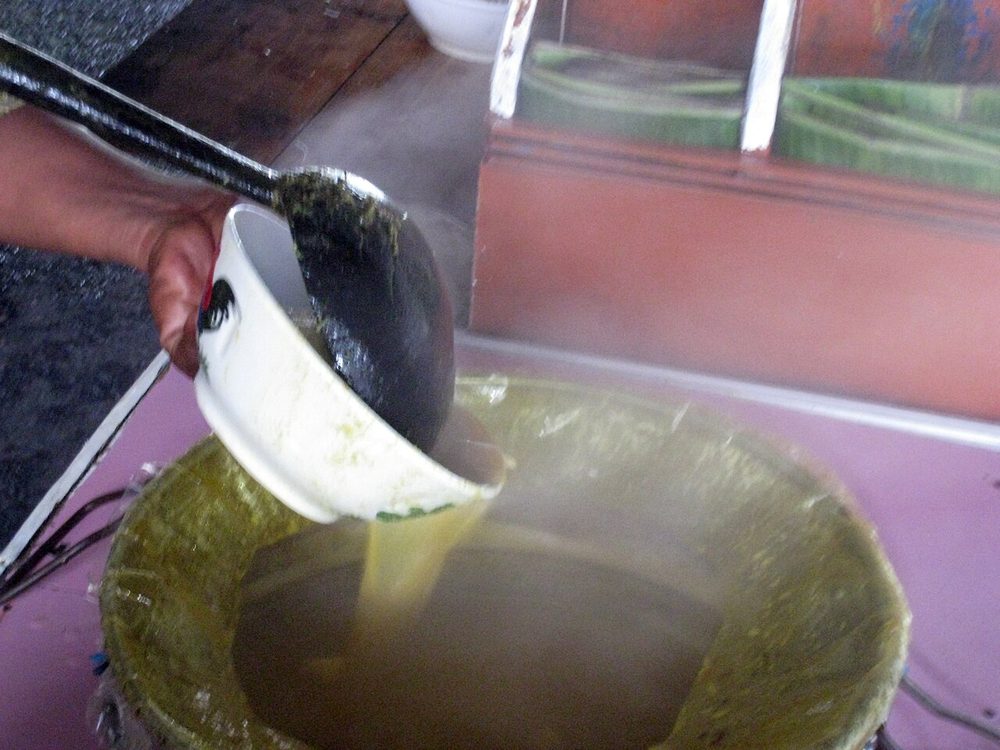
A street vendor in Bogor ladling yellow coconut broth from a large pot into a bowl
Laksa Bogor, West Java. A cart vendor ladling the turmeric-yellow coconut broth.
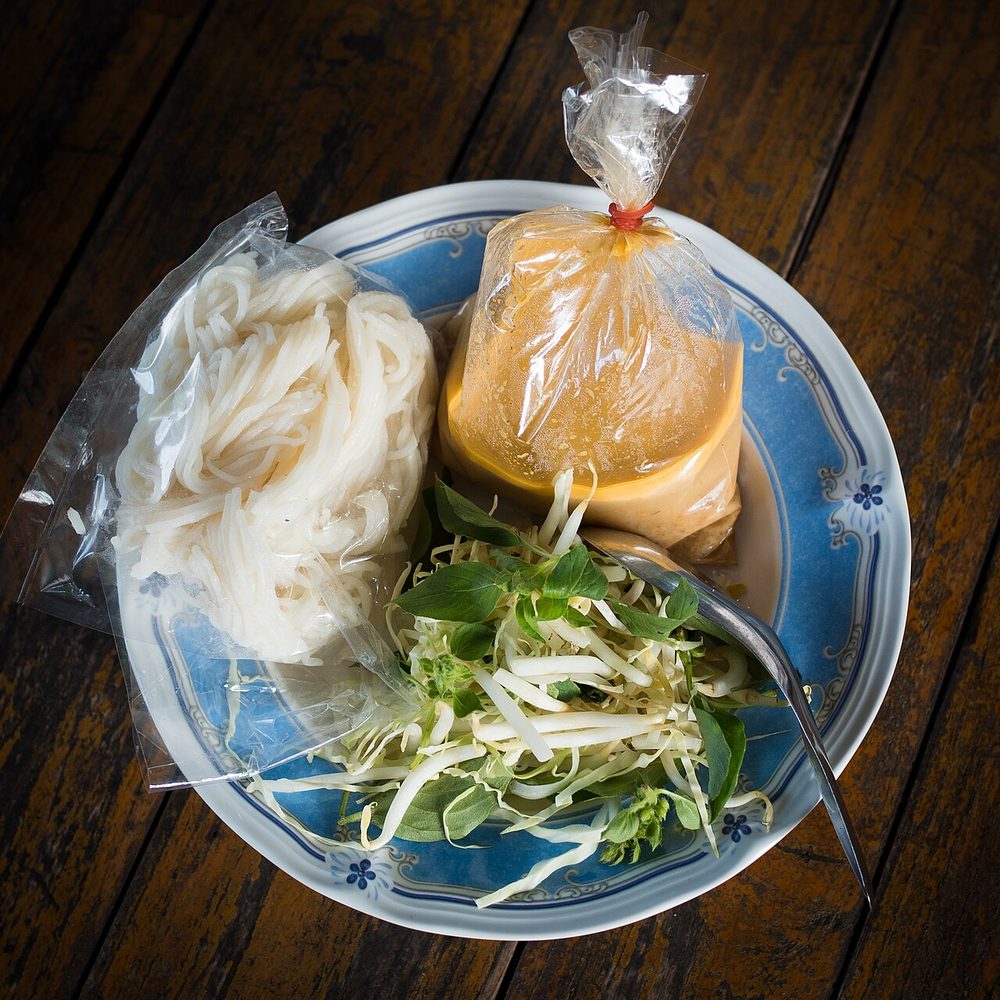
Khanom chin nam ya from a Thai market: coils of white rice noodles, a plastic bag of orange fish curry and a pile of fresh bean sprouts and herbs on a blue plate
Khanom chin nam ya, Ayutthaya. Thailand's cousin: fermented rice noodles, fish curry in a takeaway bag, raw vegetables.

How to tell what you've been served

  • Orange, creamy gravy with a faint grain, short noodles, cockles, a spoon and no chopsticks: Katong laksa. The real thing, by this site's measure.
  • Orange curry gravy with yellow egg noodles, chicken and tau pok: ordinary Singapore curry laksa, or Kuala Lumpur curry mee.
  • Thin, dark, sour broth with flaked fish, pineapple, mint and a black streak of prawn paste: Penang asam laksa.
  • Thick, greyish fish broth, a boiled egg, no coconut: northern Laksa Utara, from Kedah or Perlis.
  • White, mild coconut gravy over rolled rice sheets: laksam, from Kelantan or Terengganu.
  • Spaghetti on a plate: Laksa Johor. Not a mistake.
  • Omelette strips, shredded chicken and a wedge of lime, at breakfast: Sarawak laksa.
  • Fermented noodles with fish curry and raw vegetables: you are in Thailand, eating khanom chin.
  • A thin red soup with Thai basil and lime leaf: a Thai red curry noodle sold as laksa. Pleasant, but not laksa.
Chapter 5

The master recipe

Katong-style curry laksa, with prawn-shell stock, a fried rempah, and every topping. Give it two hours the first time; most of that is standing at the stove stirring. The quantities scale with the number of bowls.

6
A generous main-course bowl each. Fry the rempah for about 25 minutes. Everything below updates.

Rempah (spice paste)

  • 20 g dried red chillies (about 20), deseeded for less heat, soaked in hot water
  • 3 fresh red chillies
  • 200 g shallots, peeled
  • 4 garlic cloves
  • 30 g galangal, peeled and sliced
  • 20 g fresh turmeric, peeled, or 1.5 tsp ground
  • 3 lemongrass stalks, white part only, sliced
  • 6 candlenuts (buah keras); macadamias will do
  • 20 g belacan, toasted in a dry pan or wrapped in foil until it smells
  • 1 tbsp coriander seed, toasted and ground
  • 150 ml neutral oil, for frying the paste

Dried shrimp

  • 60 g dried shrimp (hae bee), soaked for 20 minutes; keep the soaking water

Prawn stock

  • 500 g shell-on prawns; the meat goes on top, the heads and shells make the stock
  • 1 tbsp oil
  • 1.75 l water, plus the shrimp-soaking water

The gravy

  • 600 ml coconut milk, freshly pressed or full-fat tinned; keep back 4 tbsp for the paste
  • 12 laksa-leaf stalks, the leaves stripped and kept for the top
  • 2 tsp salt, more to taste
  • 1.5 tsp sugar

In each bowl

  • 900 g fresh thick rice vermicelli (bee hoon), or 400 g dried
  • 300 g bean sprouts, tails picked if you have the patience
  • 6 tau pok (fried beancurd puffs), halved
  • 200 g fried fishcake, sliced
  • 500 g cockles in the shell, optional (see the warning below)
  • 3 hard-boiled eggs, halved
  • 20 g laksa leaves (daun kesum), finely shredded
  • Sambal chilli, to serve

Before you start

  • Find laksa leaf. Asian grocers sell it as laksa leaf, daun kesum, rau răm or Vietnamese coriander; it also grows easily on a windowsill. There is no true substitute. A mix of mint and coriander is the usual stand-in, and it is not the same.
  • Use a wide, heavy pan for the rempah, and more oil than seems sensible. The paste needs to fry, not stew.
  • Blend the hard aromatics first (galangal, turmeric, lemongrass, candlenut, dried chillies), then add the soft, wet ones (shallot, garlic, fresh chilli, belacan). Violet Oon's tip: blend everything at once and the paste goes watery and takes far longer to fry.
  • If you use cockles, buy them live in the shell and scrub them. Traditional stalls barely scald them. Singapore's food agency advises boiling bivalves until the shells open, then for at least three to five minutes more, and throwing away any that stay shut.

Method

  1. Make the stock. Peel the prawns, keeping heads and shells; refrigerate the meat. Fry the heads and shells in the oil in a large pot until they turn orange, dry out and smell toasty, pressing the heads to release their juices. Add the water and the shrimp-soaking water, bring to the boil and simmer for 30 to 45 minutes. Strain, pressing hard on the shells.
  2. Blend the rempah. Drain the dried chillies. Blend the hard aromatics with a splash of the soaking water to a smooth paste, then add the shallots, garlic, fresh chillies and belacan and blend again. Stir in the ground coriander. Separately, pound or blitz the soaked dried shrimp to a coarse floss.
  3. Fry the rempah. Heat the oil in the wide pan over medium-low heat and add the paste; it will spit. Stir steadily for the time shown above, scraping the base. It will go from bright red and wet to darker, thicker and glossy, the raw smell of shallot will turn sweet, and the red oil will start to pool at the edges and separate from the paste. That is pecah minyak. Add the dried-shrimp floss for the last five to ten minutes, then stir in the reserved four tablespoons of coconut milk a spoonful at a time.
  4. Make the gravy. Pour the stock onto the fried paste, add the laksa-leaf stalks and simmer gently, uncovered, for 20 to 30 minutes, stirring now and then. Take out the stalks.
  5. Add the coconut. Add the tau pok, then the rest of the coconut milk. Bring it back to a bare simmer, with a few bubbles at the edge, and hold it there. Do not let it boil hard. Season with salt and sugar until it tastes rich, savoury and just sweet.
  6. Cook the toppings. In a separate pot of boiling water, cook the cockles as above and shell them. Poach the prawns until just pink, a minute or two. Blanch the bean sprouts for a few seconds and the noodles for a minute or two until heated through.
  7. Cut the noodles. Drain the noodles and snip them through a few times with scissors, into lengths a spoon can hold.
  8. Assemble. Put noodles and bean sprouts in each bowl, lay prawns, cockles, fishcake, tau pok and egg on top, and ladle over plenty of hot gravy. Finish with a pile of shredded laksa leaf and a spoonful of sambal. Serve with a spoon, and only a spoon.
0:00Fry prawn heads and shells. Water in; stock simmering.
0:10Blend the rempah: hard aromatics first, then soft.
0:20Rempah into hot oil. Stir, low and steady.
0:45Pecah minyak: oil splits. Dried shrimp in, then coconut.
0:55Strained stock onto the paste. Laksa stalks in. Simmer.
1:25Tau pok and coconut milk. A bare simmer, never a boil.
1:35Cockles, prawns, sprouts, noodles. Cut the noodles.
1:50Assemble. Laksa leaf and sambal on top. Spoons out.

When it goes wrong

The gravy tastes raw, harsh or "green"
The rempah was under-fried: its water never cooked off, so the shallot and garlic never mellowed. Next time, keep going until the oil separates. Too little oil, too small a pan or too low a heat all slow this down.
The paste tastes bitter or acrid
It burnt, usually near the end when the water had gone and the heat was still high. Lower the heat as it thickens, and keep stirring.
The paste never stops being watery
Too much liquid in the blender, or the wet aromatics went in first. A watery paste can take twice as long to fry. Blend in two stages next time.
The gravy split, or went grainy and oily
It boiled hard after the coconut milk went in. A little red oil on top is right; curdled flecks are not. Lower the heat, whisk, and next time keep it at a gentle simmer.
It tastes flat
Salt first. If it is still flat, the stock was weak: fry the shells until dry and fragrant, and press them hard when you strain.
It is too hot
Use fewer dried chillies, or deseed all of them; the colour survives. Add a little more coconut milk to the finished gravy.
The cockles are rubbery
That is the price of cooking them safely. If you want them tender, leave them out, or add them shelled, already cooked, at the last moment.
The noodles are mushy
Fresh bee hoon only needs heating through. Blanch it briefly, drain it well and assemble at once.

Storing

The rempah is the part worth making in bulk. Fried and cooled, it keeps about a week in the fridge and around three months frozen, and turns a weeknight laksa into a twenty-minute job. The gravy keeps two or three days in the fridge without the seafood; reheat it gently, without boiling. Store noodles, toppings and gravy separately, and don't keep cooked shellfish for more than a day.

Chapter 6

The science of the rempah

Laksa is a lesson in what dissolves in what. The flavours live in fat, the savouriness comes from fermentation, and the whole dish depends on getting water out of a paste and keeping fat inside a gravy.

1 · Pecah minyak

Why the oil has to split

A rempah is mostly water: shallots, garlic, fresh chillies and lemongrass are wet vegetables. While there is water in the pan, the paste cannot get much hotter than 100 °C, so it steams rather than fries, and the sharp raw notes of shallot and garlic stay sharp. Stirring drives the water off. As it goes, the paste thickens and the oil, no longer dispersed in water, gathers at the edges and floats free: pecah minyak, "the oil breaks".

That moment matters because the temperature can now climb past 100 °C into the range where browning begins. Sugars in the shallots caramelise and the Maillard reaction between sugars and amino acids makes the deep, roasted flavours. Push on too far, much above 180 °C, and the paste starts to scorch and turn bitter.

2 · Fat carries flavour

Why so much oil

Many of the flavours in a rempah do not dissolve in water. Capsaicin, the heat in chillies, is almost insoluble in water but dissolves readily in fat; so do the colour of the chillies and turmeric and many of the aroma compounds of lemongrass, galangal and garlic. Frying the paste in oil pulls them out of the plant cells into the fat, and when the stock goes in, the coloured oil carries them through the whole pot. That is why a good laksa has a slick of red oil on top, and why a lean one tastes thin.

Capsaicin also turns to vapour well below its boiling point, from around 115 °C. That is why frying a chilli paste makes everyone in the kitchen cough.

3 · The emulsion

Why the coconut must not boil

Coconut milk is an emulsion: tiny droplets of fat held in water by coconut proteins. Heat changes those proteins. Food scientists at Penn State found that heating coconut milk between 50 and 90 °C made its fat droplets clump together, with some merging above 80 °C, and that heated milk separated more readily. A rolling boil, with its constant agitation, makes it worse. The result is a gravy that looks curdled, with flecks of protein and pools of fat.

In some dishes, rendang among them, that split is the goal. In laksa it is not. Hawkers add the coconut milk late, keep it at a bare simmer and stir it, and 328 Katong Laksa's founder has said the coconut milk must never boil.

4 · Umami

Belacan and dried shrimp

Belacan is made from tiny shrimp, salted, left to ferment, ground and pressed into blocks. Fermentation breaks the shrimp's proteins into free amino acids, glutamate prominent among them, which taste savoury. Toasting the block before use drives off some of the fishiness and adds roasted notes. Dried shrimp contribute more glutamate, and shellfish also carry nucleotides that amplify glutamate's effect when the two meet.

Leslie Tay records that as the cost of dried shrimp rose, some Katong stalls cut back on it, and that the "umami punch" of the gravy faded with it. It is the dried shrimp, more than anything, that makes Katong laksa taste like Katong laksa.

5 · Safety

The trouble with cockles

Blood cockles are filter feeders. They live in coastal mud and concentrate whatever is in the water around them, including viruses from sewage. Traditionally, hawkers shell them raw and dip them in hot gravy for a few seconds, so they stay plump and bloody. That is exactly how Singapore had a series of hepatitis A outbreaks. A 2011 review in the Annals of the Academy of Medicine, Singapore lists seven outbreaks linked to cockles between 1978 and 2002, and names laksa as one of the dishes to which raw shucked cockles are added. It warns that a brief scald will not inactivate the virus, which can survive boiling temperatures for several minutes.

There have been no shellfish-linked outbreaks in Singapore since 2002, and stalls are inspected. But the advice from the Singapore Food Agency is to boil bivalves until they open and then for three to five minutes more, and for pregnant women, young children, older people and anyone with a weakened immune system to avoid raw or undercooked shellfish. At home, cook them through or leave them out.

The four largest cockle-linked outbreaks:

1983
161 cases
1991
70 cases
1992
70 cases
2002
159 cases
6 · Leaf and sour

Laksa leaf, tamarind and the asam branch

Laksa leaf, Persicaria odorata, is not related to coriander or mint, but it smells a little like both. Its aroma is dominated by long-chain aldehydes, compounds also found in coriander leaf and citrus peel. One analysis of its essential oil found dodecanal at about 44 per cent and decanal at about 28 per cent; a Malaysian study of the closely related Persicaria minor, also sold as daun kesum, found the same two compounds dominant. That is why the leaf goes on raw, at the end: the aldehydes are volatile and fade with cooking.

Asam laksa replaces coconut fat with acid. Tamarind's sourness comes mainly from tartaric acid; asam gelugur, the dried slices of a garcinia fruit used in Penang and Kedah, has a different, sharper sourness of its own. Acid sharpens the fish, cuts its richness, and makes the sweet pineapple and the salty prawn paste on top taste brighter.
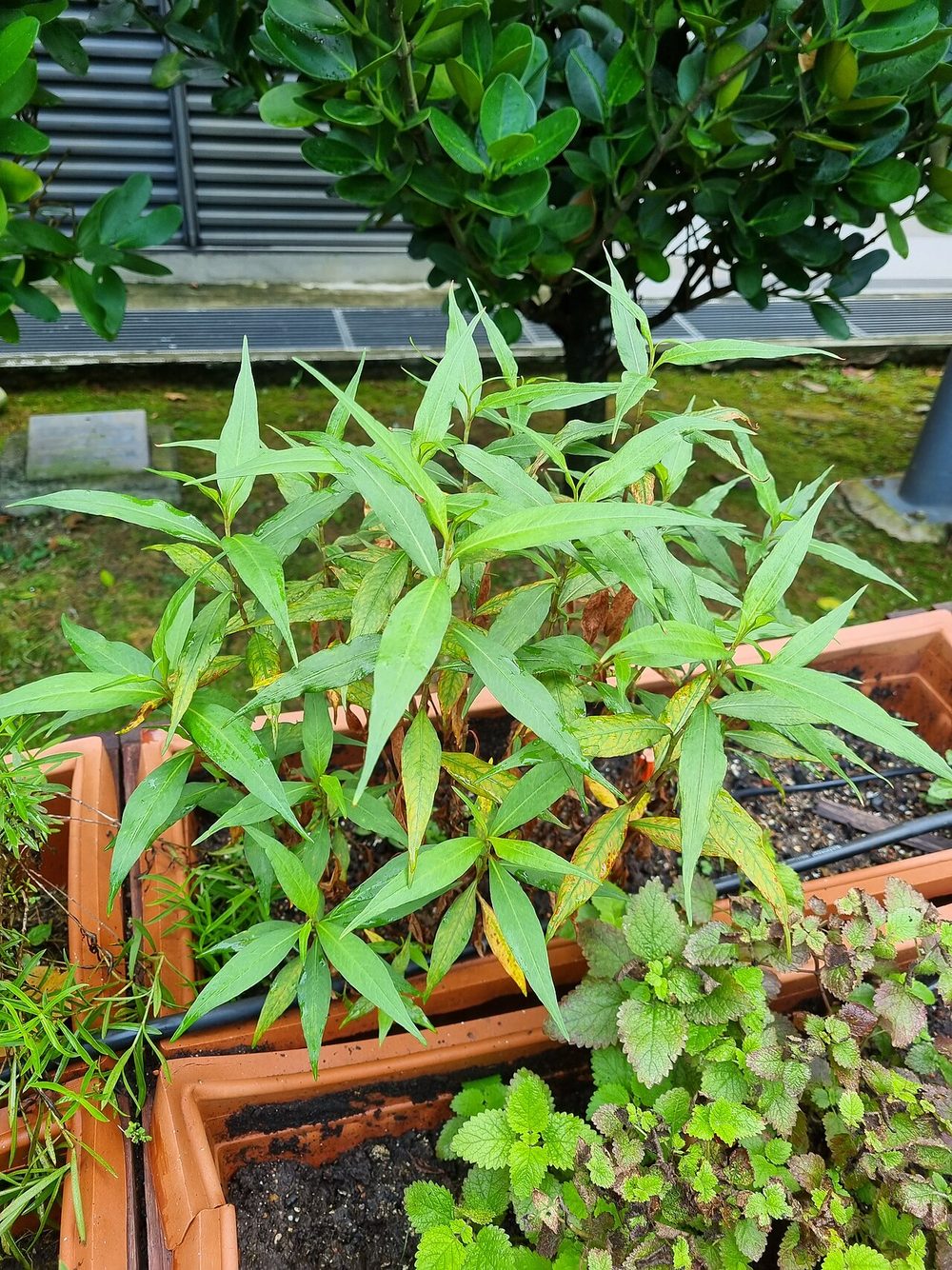
Laksa leaf plants, with long, narrow, pointed leaves, growing in a planter in a Singapore community garden
Laksa leaf, growing in Singapore. Persicaria odorata, Vietnamese coriander. Easy to grow, impossible to substitute.
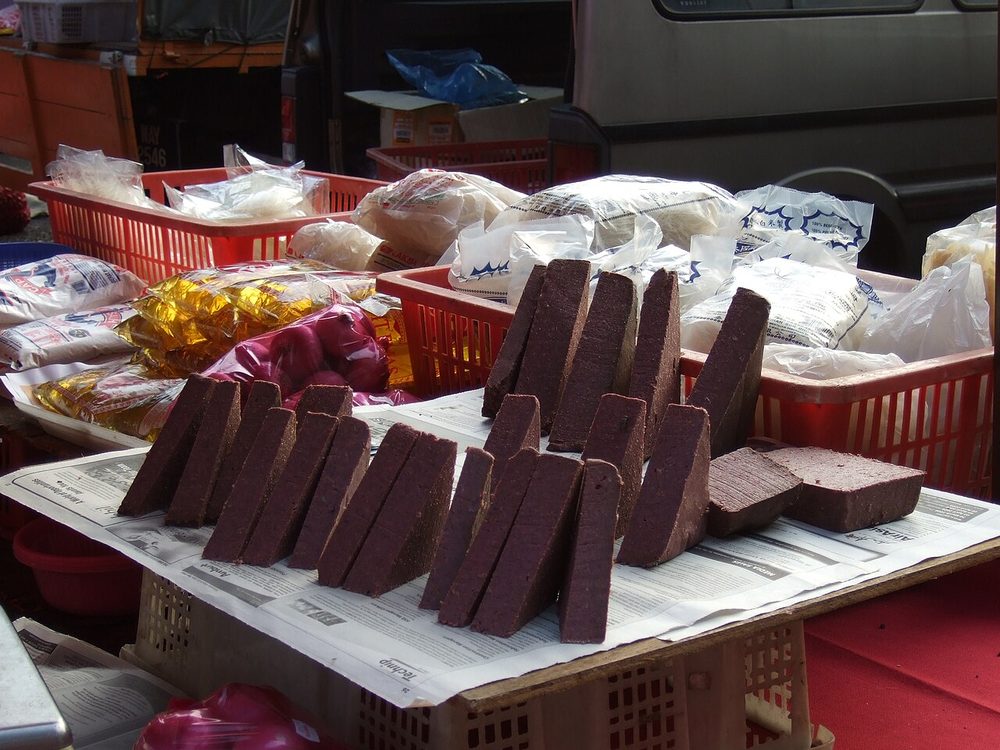
Dark purple-brown blocks of belacan, fermented shrimp paste, stacked for sale in a Malaysian market
Belacan, for sale in Malaysia. Fermented shrimp, ground and pressed into blocks. A little goes into the rempah, toasted first.
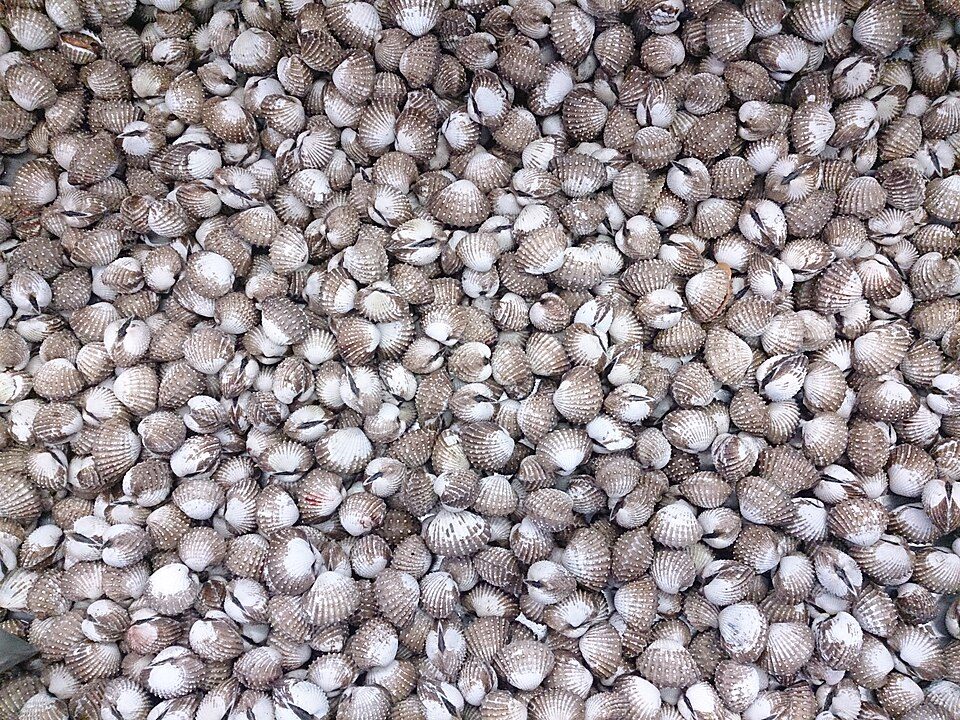
A heap of grey-white ridged blood cockles filling the frame
Blood cockles. The traditional Katong topping, and the one that needs the most care.
Chapter 7

Katong and the laksa wars

Laksa is cooked at home for weddings and sold in the street for lunch. On one stretch of East Coast Road, it has also been fought over for twenty-five years.

A dish of the home and the street

Singapore's heritage board describes laksa as something eaten in coffee shops, hawker centres and restaurants, and also at home, at family gatherings and at weddings. In Peranakan households it was a dish for occasions: a pot of gravy big enough for the whole family, the toppings laid out for everyone to build their own bowl. In the street it was the opposite, a quick bowl from a pushcart, eaten standing up with a spoon. Both versions are still alive.

It is also one of the dishes that crosses Singapore's communities. Chinese, Malay and Peranakan stalls sell it, and halal laksa, made without pork and with seafood or chicken, is easy to find. The Malay laksa Siglap and laksa Johor and the Peranakan Katong laksa sit on the same island, a few kilometres apart.

Cream and pastel Peranakan terrace houses with ornate facades and front gardens on Koon Seng Road, Singapore
Koon Seng Road, 2024. Peranakan terrace houses in Joo Chiat, the neighbourhood that gave Katong laksa its customers.
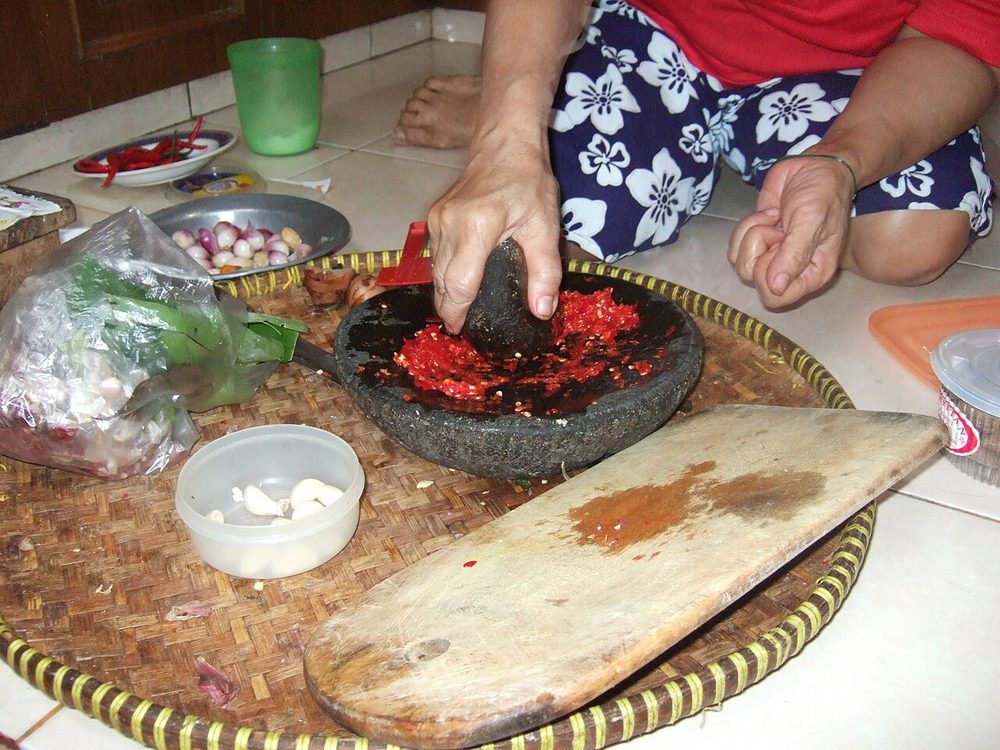
A woman pounding red chilli paste in a stone mortar on a woven tray, with shallots and garlic beside her, in a home kitchen
Pounding the paste by hand. A home kitchen in Indonesia. In Peranakan lore, a future mother-in-law could judge a young Nyonya by the rhythm of her pounding.
The hawker centre

Curry laksa at every food centre, S$3 to S$7.50 a bowl, often with yellow noodles and chicken.

East Coast Road

Katong laksa at the old coffee shops near Ceylon Road. Cut noodles, cockles, a spoon.

The Nyonya home

A big pot for a family gathering or a wedding, everyone assembling their own bowl.

The claypot stall

Laksa served bubbling in its pot, the gravy slow-cooked with chilli padi and belacan.

The packet

Instant laksa noodles and jars of paste. Singapore's Prima Taste and Kuching's family brands export the flavour.

Abroad

Darwin's October festival, Melbourne's laksa bars, London's Malaysian and Singaporean kitchens.

The laksa wars

The fight over Katong laksa is about a name and a recipe that nobody owns. Janggut and his brother made Peranakan-style laksa famous in Katong. Their family ran Marine Parade Laksa at 49 East Coast Road for decades. In 1998, when the rent went up and the family left, a former assistant took over the space and opened 328. A year later the landlord took the space back and opened her own laksa stall in it, so 328 moved next door. Janggut's relatives opened again a few doors along. For a while, five stalls within a few doors of each other were selling Katong laksa, several with "original" on the sign.

The press covered it like a sporting season. Violet Oon, the Nyonya cook and food writer, judged the bowls. Two stalls closed. 328 grew fastest, with photographs of film stars on its walls, Gordon Ramsay's defeat in 2013 and, eventually, franchised outlets; some regulars say the bowls suffered for it. Janggut's family still sells laksa under his name. National Geographic, visiting in 2019, found that the feud had largely faded. On East Coast Road, nobody quite agrees.

Whose dish? Food and the border

In September 2009 Malaysia's tourism minister said that other countries were hijacking Malaysian food, and named laksa alongside chicken rice and chilli crab. Singapore heard it as an accusation, and Indonesia could have, though she named no country. Malaysian commentators pointed out that the minister's own government had not put Penang asam laksa on its national heritage list; when Malaysia gazetted ten heritage dishes in 2024, laksa was still not among them. Singapore, meanwhile, had put laksa on its own heritage inventory in 2019.

The honest position, and the one this site takes, is that laksa belongs to the whole Malay world, to the Peranakan cooks of the Straits who made its most famous version, and to every town that has its own. It is the least ownable dish on this site, which is part of why people keep trying.

Abroad

Laksa travels further than most hawker dishes. Australia took to curry laksa early, and Darwin, with its long ties to Southeast Asia, calls itself the country's laksa capital. Its Parap market stalls have rival followings, and since 2019 the city has held an International Laksa Festival every October, with a Golden Bowl award, mystery judges and, at the 2024 edition, more than 180 laksa dishes, some of them laksa-flavoured ice cream. In London, Mandy Yin's Sambal Shiok began as a street-food stall in 2013 and became a laksa bar on Holloway Road.

Close-up of a bowl of curry laksa in Melbourne with yellow egg noodles, tau pok, chicken and spring onion in orange gravy
Curry laksa, Box Hill, Melbourne. The Australian bowl: yellow noodles, tau pok and an orange gravy, at around nine Australian dollars.
"#Kuching Breakfast of the Gods" Anthony Bourdain, on Sarawak laksa, Instagram, May 2015

Bourdain's caption did for Sarawak laksa what his 2008 visit to Tian Tian did for chicken rice. He had eaten it at Choon Hui Cafe in Kuching on No Reservations in 2005, came back for Parts Unknown in 2015, and the shop has had a queue ever since. He was also fond of Penang's asam laksa, and said on television that it was the one thing he always had to eat in Malaysia.

Chapter 8

Glossary and questions

Every term used on this page, then the questions people ask most, then where to read more.

Glossary

Asam
Sour. In cooking, tamarind or dried garcinia, used to sour a broth.
Asam gelugur / asam keping
Dried slices of a sour garcinia fruit, used in northern and Nyonya laksa.
Baba, Nyonya
Peranakan men and women. Nyonya cooking is the Peranakan cuisine.
Batu lesong
The stone mortar and pestle used to pound rempah.
Bee hoon
Rice vermicelli. Laksa uses the thick kind, sometimes called laksa noodles.
Belacan
Fermented shrimp paste pressed into blocks; toasted before use. Terasi in Indonesia.
Bunga kantan
Torch ginger flower, shredded into asam and northern laksa.
Buah keras
Candlenut. Ground into the rempah for body and richness.
Daun kesum
Laksa leaf, Vietnamese coriander, Persicaria odorata. Also called daun laksa.
Hae bee
Dried shrimp, in Hokkien. Udang kering in Malay.
Hae ko
Thick, black, sweet prawn paste, spooned onto Penang asam laksa.
Hum, see-hum
Blood cockles, in Hokkien.
Janggut
Malay for "beard", and the nickname of Ng Juat Swee, the Katong laksa pioneer.
Kerisik
Grated coconut toasted dark and pounded to an oily paste. Used in Johor laksa.
Kuah
Gravy or broth. In Singapore English, laksa's broth is the "gravy".
Laksam
The rolled rice-sheet laksa of Kelantan and Terengganu, with white fish-and-coconut gravy.
Lemak
Rich, creamy with coconut.
Lengkuas
Galangal, a rhizome related to ginger, with a piney, citrus flavour.
Pecah minyak
"The oil breaks": the moment a frying rempah releases its oil.
Peranakan
The Straits Chinese, descendants of Chinese traders and local women in Melaka, Penang and Singapore.
Rempah
A spice paste, pounded or blended, then fried.
Serai
Lemongrass.
Tau pok
Fried beancurd puffs, which soak up the gravy.
Ulam
Raw herbs and vegetables eaten alongside a dish.

Questions

Is laksa Singaporean, Malaysian or Indonesian?

All three. The word was in use in Java by the 1390s; the coconut-gravy versions were shaped by the Peranakan of Melaka, Penang and Singapore; and Malaysia and Indonesia each have a laksa in almost every region. Singapore lists laksa as part of its intangible cultural heritage. No country can claim the whole family.

Why is Katong laksa eaten with only a spoon?

The noodles are cut short before they go into the bowl. Who started it, and why, is disputed: Marine Parade Laksa on East Coast Road, Janggut himself (so customers could eat quickly), or Sungei Road Laksa. Whatever the reason, it lets you eat noodles and gravy in the same mouthful.

Where does the word laksa come from?

Probably from a Persian word for noodles, lakhsha, which reached the Malay world through trade. It has nothing to do with the Malay number laksa, "ten thousand", which comes from Sanskrit, and the Chinese "spicy sand" story is a later folk etymology. Nobody has proven it either way.

What's the difference between curry laksa and asam laksa?

Curry laksa has coconut milk, a fried spice paste and usually a prawn or chicken stock. Asam laksa has no coconut: it is a sour broth of fish and tamarind, topped with raw vegetables, fruit and herbs.

Is curry laksa the same as curry mee?

In Kuala Lumpur, more or less. Curry mee uses yellow egg noodles and often long beans and cockles. Singapore curry laksa uses thick rice noodles, sometimes mixed with yellow; Katong laksa uses only rice noodles, cut.

What can I use instead of laksa leaf?

Nothing quite works. Mint and coriander together are the usual stand-in. Laksa leaf, sold as Vietnamese coriander or rau răm, is in many Asian grocers and grows easily in a pot.

Are the cockles safe?

Undercooked cockles have caused several hepatitis A outbreaks in Singapore, most recently in 2002. At home, buy them live, boil them until they open and then for three to five minutes more, and throw away any that stay shut. If you're pregnant or have a weakened immune system, avoid raw or undercooked shellfish.

Why did my gravy split?

It boiled hard after the coconut milk went in. Add the coconut late and keep it at a bare simmer. A little red oil floating on top is normal and good.

Can I use a ready-made paste?

Yes, and many hawkers in Kuching do for Sarawak laksa. A good bought paste plus a real prawn-shell stock and fresh laksa leaf gets you most of the way. Fry the paste anyway, until the oil separates.

Did 328 Katong Laksa really beat Gordon Ramsay?

Yes. In the Singtel Hawker Heroes Challenge on 7 July 2013, the public voted for 328's laksa over Ramsay's by 59.5 per cent to 40.5.

Where can I eat good laksa outside Asia?

Darwin, especially in October during its festival; Melbourne, where laksa bars have traded for decades; and London, where Malaysian and Singaporean cooks serve it. Look for laksa leaf on top and a gravy with some depth to it.

Further reading

  • Leslie Tay, The End of Char Kway Teow and Other Hawker Mysteries (Epigram, 2010), and his three-part "Katong Laksa Story" on ieatishootipost.sg. The best account of Janggut, Roxy and Marine Parade.
  • Khir Johari, The Food of Singapore Malays: Gastronomic Travels through the Archipelago (Marshall Cavendish, 2021). The Malay side of Singapore's laksa, and the archipelago behind it.
  • Sharon Wee, Growing Up in a Nonya Kitchen (Marshall Cavendish, 2012). A Peranakan family's recipes and kitchen life.
  • Sylvia Tan, Singapore Heritage Food: Yesterday's Recipes for Today's Cook (revised 2014). Recipes and memories of the dishes of an older Singapore.
  • Temasek Polytechnic, Singapore Hawker Classics Unveiled (Marshall Cavendish, 2015). Twenty-five hawker dishes, analysed.
  • J. M. J. Catenius-van der Meijden, Nieuw volledig Oost-Indisch kookboek (1902). The Dutch Indies cookbook with early laksa recipes, free on Project Gutenberg.
  • Lee and colleagues, "Changing epidemiological patterns of hepatitis A infection in Singapore", Annals of the Academy of Medicine, Singapore (2011). The source for the cockle outbreaks.
  • National Heritage Board, Singapore, the Roots.sg intangible cultural heritage entry for laksa (2019), and the SG101 and NLB Infopedia articles on Katong laksa and East Coast Road.
  • National Geographic, "Deconstructing laksa" (2019), and Atlas Obscura, on intermarriage and the Peranakan kitchen (2016).